An Unscripted Window of Opportunity
Most landscape photographs are born from months of meticulous planning—returning to the same coordinate time and again, waiting for a forecast to align. But every so often, the mountains offer a rare, unscripted window of opportunity. I was navigating a backcountry dirt road in Ouray County, exploring the terrain for future opportunities, when I pulled off to study the map. Below me lay a breathtaking expanse: Cimarron Ridge, flanked by groves of aspen trees at the absolute pinnacle of their autumn peak. The vibrant, golden leaves created a stunning contrast against the ridge’s distinct, iron-stained red rock and deep mineral-rich cliffs.
Reading the Horizon
It was the middle of the day—typically a time to wait out the harsh light. My initial instinct was to map the location and plan a return for sunrise or sunset. But as I sat looking over the map, contemplating a drive toward Mount Sneffels, a flash in the far distance caught my eye. Dark, heavy clouds were rolling across the high peaks of the San Juans, carrying a distant light show of lightning. I watched the horizon for ten minutes, tracking the storm’s trajectory. It was heading straight for the ridge.
Choosing the Technical Strategy
The potential was undeniable: the brilliant gold of the aspens and the deep, rugged rust of the cliffs, all framed by the moody, dramatic canvas of an advancing alpine storm. I stepped out of the truck and set up the camera. Because the storm was moving quickly, standard panoramic stitching wouldn’t work—the fast-moving clouds would blur and tear across multiple frames. Instead, I opted for a wide-angle lens, positioning myself far enough back to capture the entire sweep of the ridge in a single frame that I could later crop into a panoramic format.
A Sudden Shift in the Weather
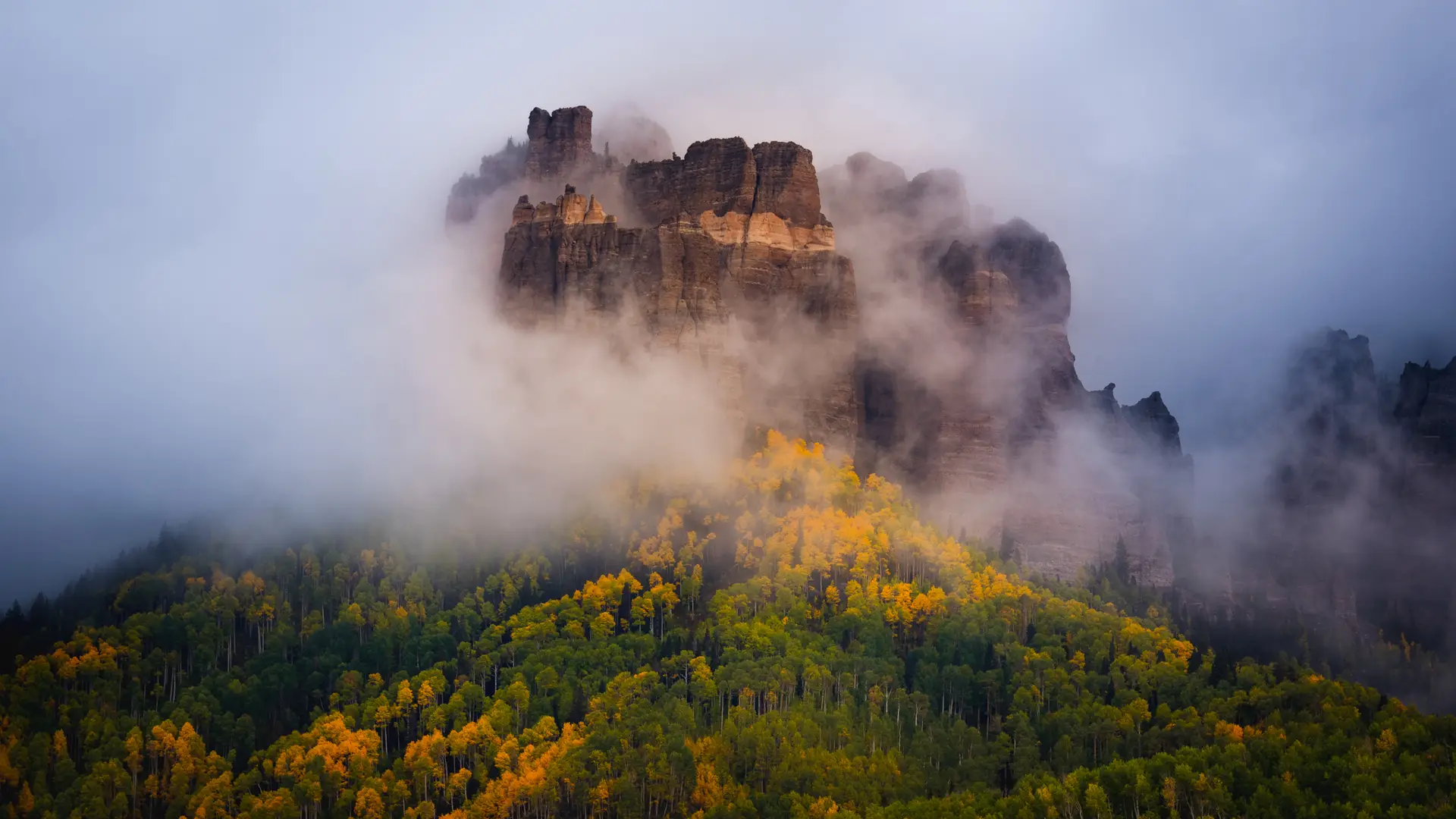
For the next thirty minutes, I waited as the dark, heavy clouds slowly crept into the frame. But alpine weather is entirely unpredictable. As the front arrived, the clouds began to shear over the mountain rather than filling the entire sky, leaving a large corner of pure blue in the frame. The wide panorama I had envisioned was falling apart. But looking through the lens, the main peaks were stunning, with the dark storm clouds perfectly painted around the jagged rock. I knew I had to pivot immediately to salvage the moment.
Adapting with a Telephoto Lens
Working fast right next to the vehicle, I grabbed my camera bag, swapped out the wide-angle, and mounted my telephoto lens. I zoomed in tight on the peaks, framing the dramatic collision of rock and storm, dialed in my settings, and pressed the shutter. Instantly, the clouds vanished. It was as if someone had flipped a light switch; the storm dissolved, leaving nothing but a clear blue sky. I had captured exactly one frame. Standing there in the sudden stillness, I checked the back of the camera, hoping against hope that the focus and exposure had locked in time. I had caught it—the perfect, fleeting moment where the red cliffs peeked through the heavy dramatic weather right before it dissolved.
A Fleeting Moment in the High Country
Just a minute or two later, another vehicle pulled up. The windows rolled down, and a couple of photographers looked out at the empty blue sky. They looked at me and asked, “Did we miss it?” I offered a polite, quiet nod, keeping my excitement to myself. “Yeah, the storm came in and went already.” They replied with a quick, “Oh, bummer,” before driving on their way.
The Unpredictable Soul of the San Juans
It wasn’t until I got back to the studio and loaded the raw file onto the screen that the gravity of the moment truly hit me. Nature doesn’t operate on our schedule. When you’re in the field, success isn’t just about having a plan—it’s about having the instinct to readapt the second that plan changes. Ultimately, that unpredictability is what makes fine-art landscape photography in the San Juan Mountains so rewarding. Today, this image of Cimarron Ridge stands as a permanent reminder of that rush—capturing a fleeting collision of light, golden aspens, and mountain storm that existed for only a single frame. For any photographer exploring the backcountry of Ouray County, it’s proof that some of the best landscape photography happens when you least expect it, as long as you’re ready to react.