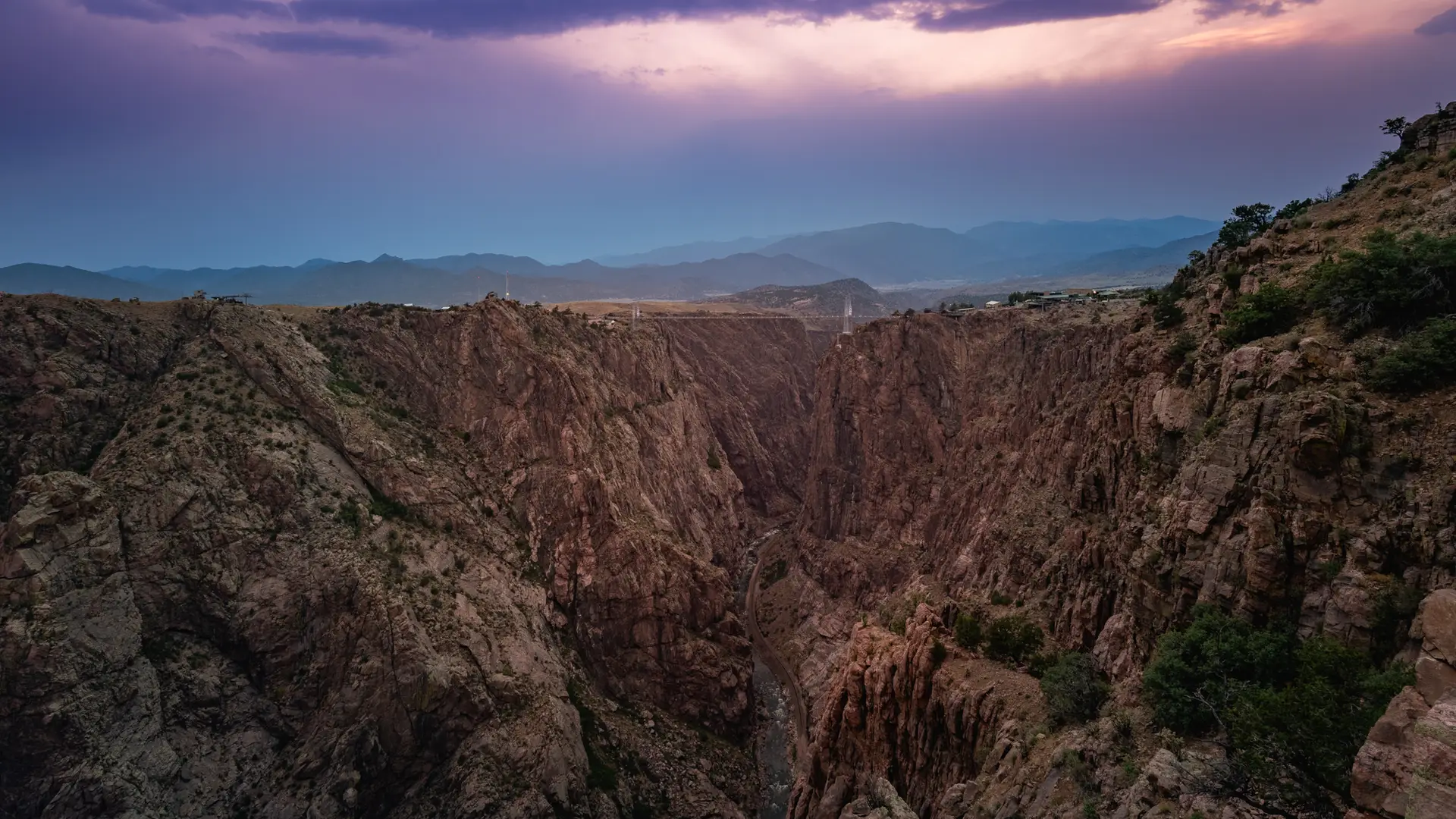
Royal Gorge Photography Overview & History
Formed over millions of years as the Arkansas River cut through a rising granite plateau, the Royal Gorge became a focal point of westward expansion and industrial competition in the late 1870s during the “Royal Gorge War” between rival railroads. The canyon’s fame grew exponentially in 1929 with the construction of the Royal Gorge Bridge, which spans 1,260 feet across the rim and hangs 956 feet above the river.
This location is popular because it provides an immediate study in extreme vertical depth and contrasting geometric lines against raw, jagged cliffs. Having the Royal Gorge in your landscape portfolio demonstrates an ability to manage massive dynamic range and showcase sheer architectural and natural scale in a single, balanced frame.
The physical layout of the area consists of a high, flat desert plateau at roughly 6,700 feet elevation, densely covered in piñon pine and juniper. This plateau abruptly drops into a sheer, vertical chasm. The main park infrastructure, visitor center, and primary trailheads sit entirely on the north rim of the canyon, which serves as the most accessible and versatile side for landscape composition.
Photographing Royal Gorge: What to Expect on Location
Finding the right vantage point on the north rim requires navigating a mix of developed park land and raw public trails. Inside the official park gates, you face high security fencing and viewing platforms that can restrict your low-angle compositions. However, by utilizing the public trail network just outside the park gates, you can find unobstructed granite ledges where the canyon drops away cleanly without commercial infrastructure interfering with your frame.
The main challenge on location is managing the extreme contrast. Because the canyon walls are narrow and steep, the bottom of the gorge falls into deep shadow quickly, while the upper rims catch direct sunlight. Tracking the light windows is critical; during midday, the harsh overhead sun flattens the texture of the granite walls, making early morning and late evening the primary windows to capture dimensional light skimming across the rock faces.