How to Photograph the Painted Wall in Black Canyon of the Gunnison
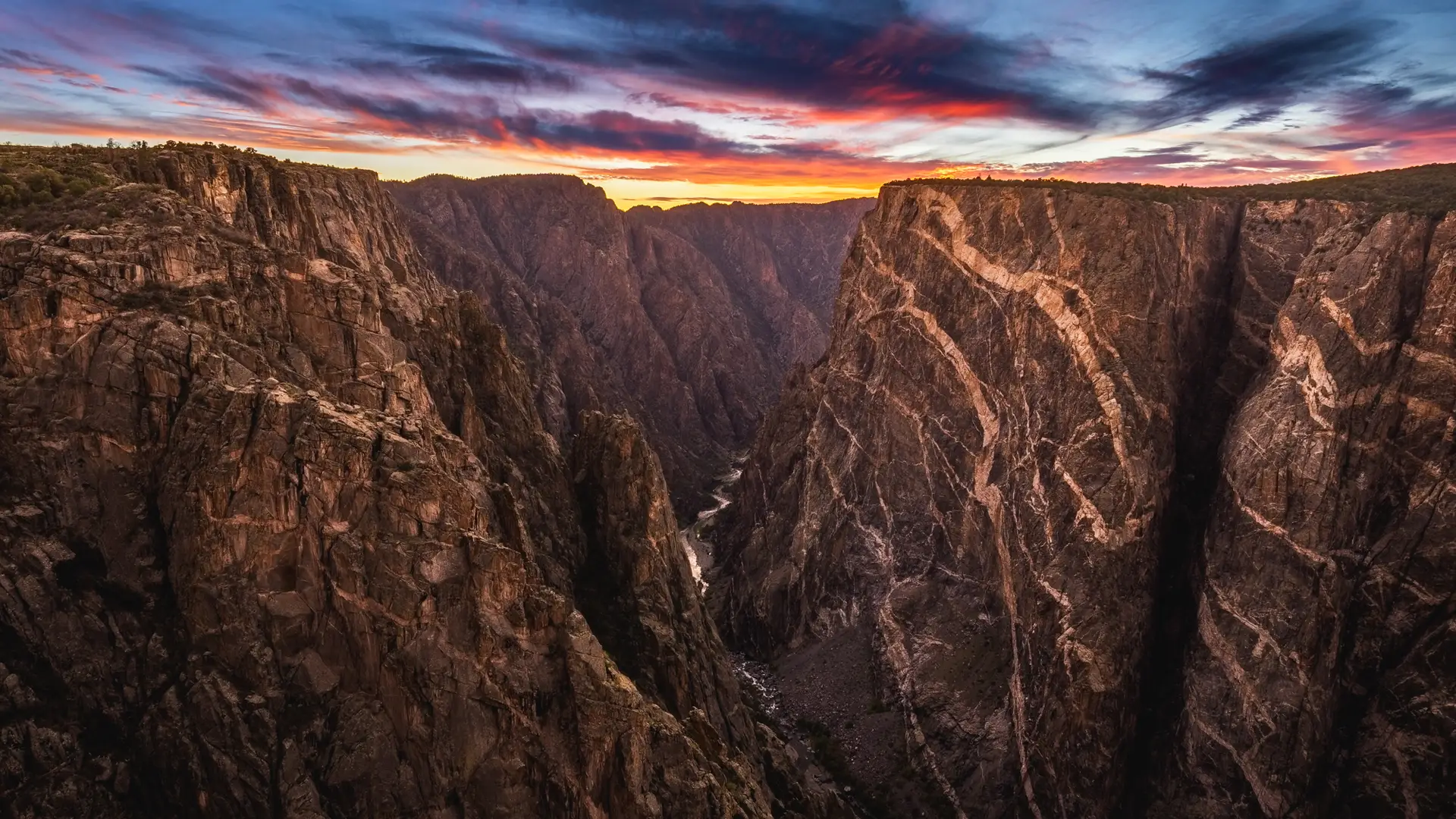
The Painted Wall stands as the highest sheer cliff in Colorado, dropping 2,250 feet to the Gunnison River. Photographing this wall at sunset requires managing intense sky highlight levels against dark canyon shadows. Because you are pointing your camera directly into the setting sun, standard dynamic range exposures will fail to capture shadow detail along the canyon floor without completely clipping the sky highlights.
To balance these lighting conditions, rely on exposure bracketing rather than focus bracketing. Set your camera frame sequence to take 7 exposures at 1.7-stop increments. This sequence captures the full range from sunlight over the rim down to the shadowed base of the canyon. You can then merge these bracketed exposures in post-processing into a single high dynamic range image.
A heavy-duty tripod is non-negotiable for this location. Because exposure bracketing requires taking multiple frames that must align perfectly during focus and HDR merging, handheld shooting will introduce alignment errors. Furthermore, as the sun drops below the rim, shutter speeds slow down significantly inside the darkened gorge. Maintaining a stable tripod setup ensures precise frame alignment across all 7 bracketed exposures without relying on elevated ISO settings that introduce digital noise.
Managing atmosphere and reflection in the canyon requires careful filter management. Prior to sunset, heat and atmospheric moisture create haze inside the gorge. Mounting a circular polarizer (CPL) helps reduce haze and separate the intrusive light layers to restore midground depth. However, as the sun started going down, the haze started dropping, but more importantly, the reflection of the water went away.
At this stage, remove the CPL filter. Leaving a polarizing filter attached neutralizes light reflections off the Gunnison River far below. Without that specular highlight, the bottom of the gorge turns into a flat, dark void. Removing the filter allows direct light reflections off the water surface to cut through the shadows, creating leading lines along the dark canyon floor and adding essential visual structure to your frame.